
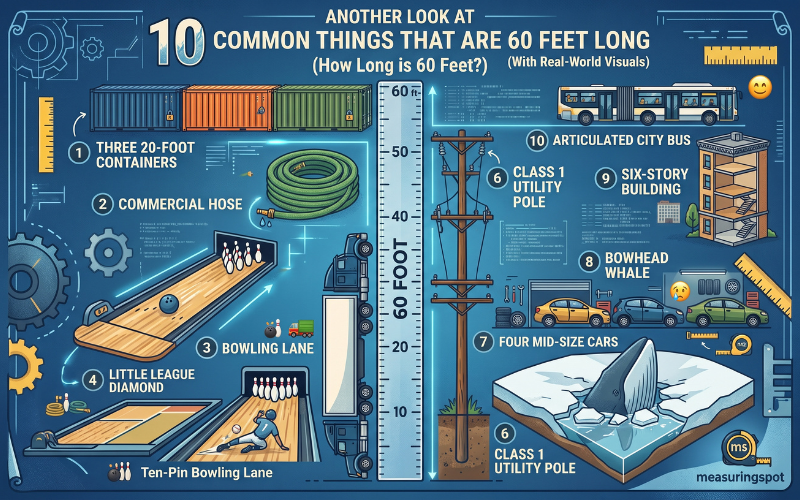
Sixty feet is one of those distances that lives right on the edge of human perception. It is too long to estimate using your arm span, yet short enough to take in with a single glance across a parking lot or down a street. When someone asks, How Long is 60 Feet, having concrete references transforms an abstract measurement into something tangible.
Quick Reference: How Long is 60 Feet at a Glance? ⚡
If you need an immediate mental yardstick, keep these quick conversions and equivalents in mind:
- In Metric: Exactly 18.288 meters (often rounded to 18.3 m).
- In Inches: 720 inches.
- In Yards: 20 yards (one-fifth of an American football field, end zones excluded).
- In Human Paces: Roughly 22 to 25 normal walking strides for an average adult.
- In Sedans: About 4 standard family cars parked bumper-to-bumper.
- In School Buses: Roughly 1.5 standard yellow school buses.
- In Mattresses: Roughly 9 standard queen-size beds laid head-to-toe.
10 Common Things That Measure Roughly 60 Feet 🔍
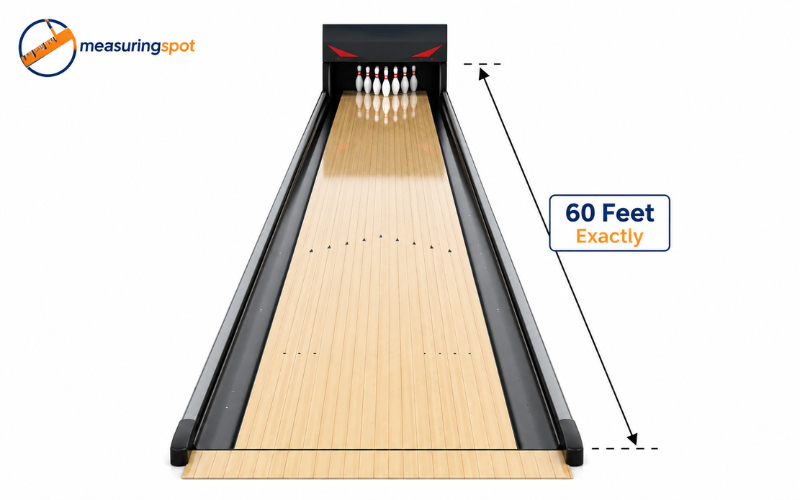
1. A Standard Ten-Pin Bowling Lane 🎳
One of the most precise everyday examples of this distance is right at your local bowling alley. A regulation ten-pin lane measures 60 feet from the foul line to the center of the headpin (pin number 1).
When you release a 14-pound ball, it travels across exactly 60 feet of polished maple and pine before making impact. Including the pin deck and approach area behind the line, the overall wooden installation is longer, but the active playing field is built to this exact 60-foot standard worldwide.
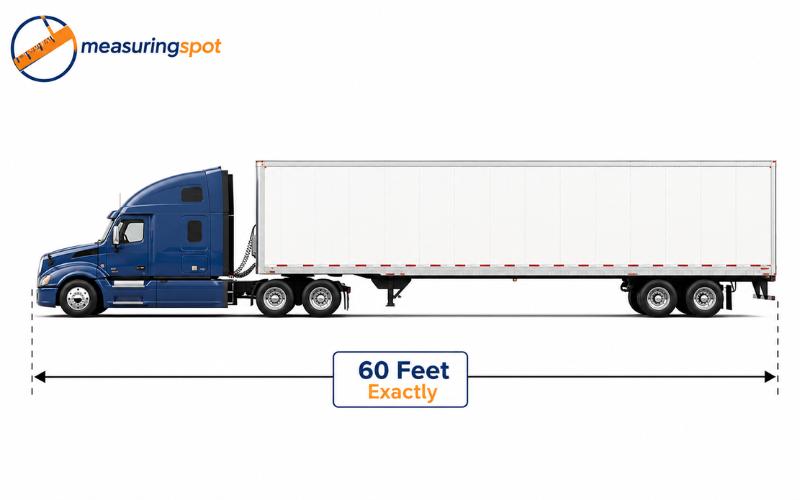
2. A Tractor-Trailer Combination (Semi-Truck Rig) 🚛
Most drivers pass semi-trucks on the highway daily without considering their total footprint. A standard dry-van trailer measures 53 feet on its own, but when coupled to a standard day-cab tractor, the entire rig typically falls between 60 and 65 feet from front bumper to rear door.
Shorter regional trailers measuring 45 or 48 feet paired with an extended sleeper cab sit right on the 60-foot mark. If you look at an eighteen-wheeler parked next to a loading dock, you are looking at roughly 60 feet of steel, rubber, and cargo space.
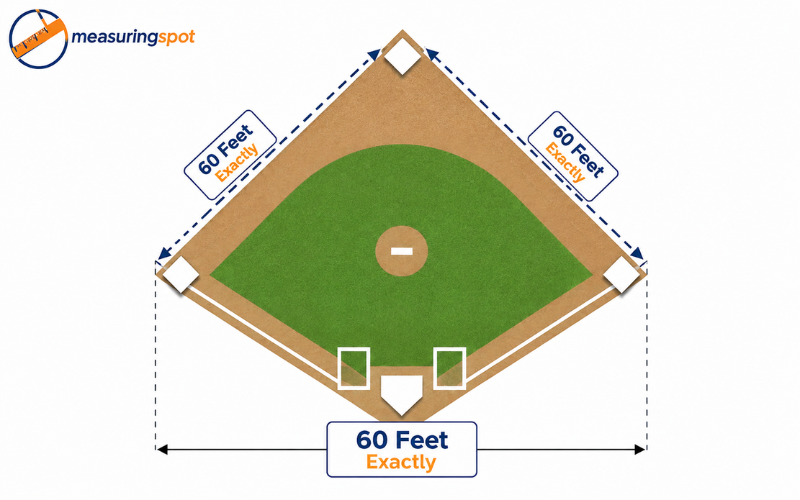
3. The Distance Between Bases on a Little League Diamond ⚾
While Major League Baseball spaces its bases 90 feet apart, Little League baseball scales the infield down for younger players. On a standard Little League diamond (majors division, ages 9 to 12), the distance along the baseline between home plate and first base—and between every base thereafter—is exactly 60 feet.
Additionally, the regulation distance from the front of the pitcher’s rubber to the back point of home plate in standard youth ball is 46 feet, but the basepaths form a strict 60-foot square.
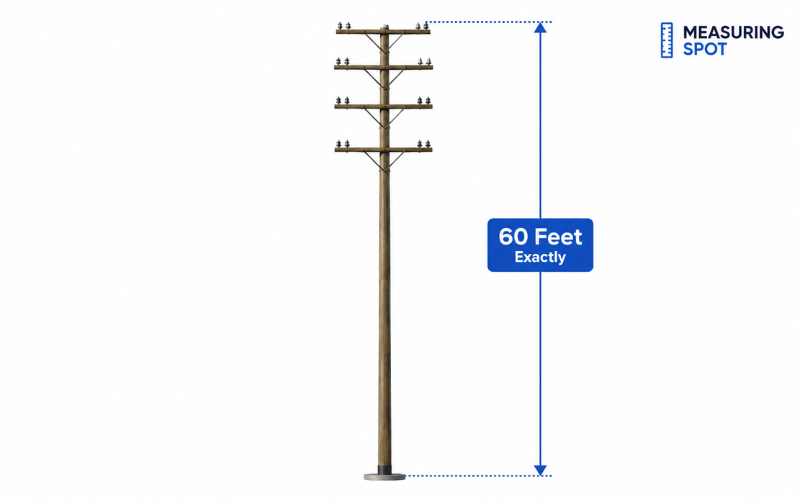
4. A Five-to-Six-Story Commercial Utility Pole 🪵
Utility poles lining residential streets usually stand between 35 and 40 feet tall, but high-voltage distribution lines and multi-utility poles along major avenues and industrial corridors are much larger.
Standard Class 1 and Class 2 heavy wooden utility poles manufactured for cross-town lines commonly measure 60 to 65 feet in total length. Around 8 to 10 feet of the base is buried into the ground for structural stabilization, leaving approximately 50 to 52 feet towering into the air.
5. Four Mid-Size Cars Parked Bumper-to-Bumper 🚗
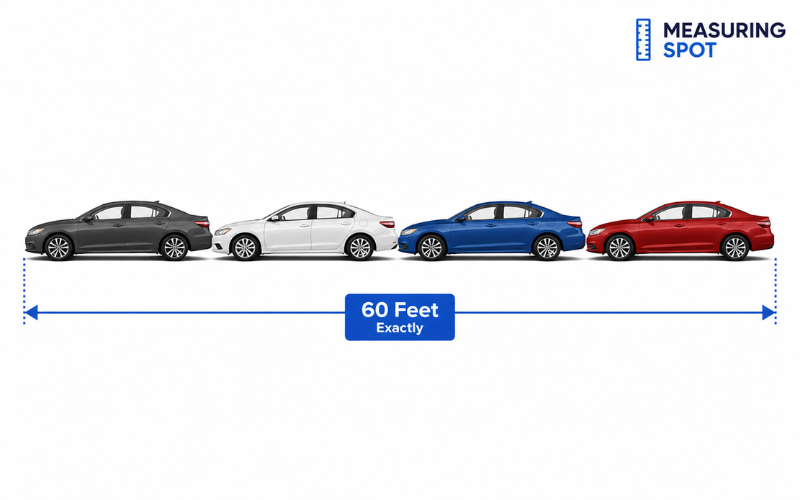
An average mid-size family vehicle—like a Toyota Camry, Honda Accord, or Subaru Outback—measures roughly 15 feet in overall length (approx. 190 to 194 inches).
Line up four of these cars bumper-to-bumper with zero gap between them, and the collective chain measures virtually spot-on at 60 feet:
$$4 \times 15\text{ ft} = 60\text{ ft}$$
This makes street parking spaces an easy visual trick: four parallel street parking spots without access gaps stretch across 60 to 70 feet of curb.
6. An Adult Female Bowhead Whale 🐋
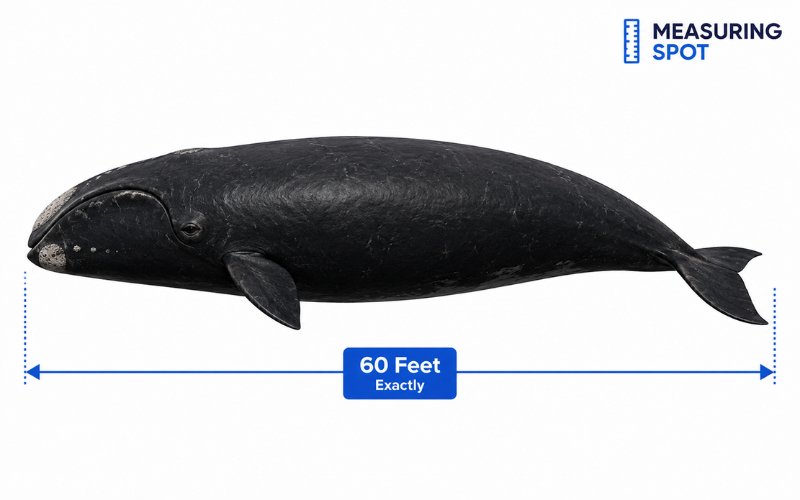
The bowhead whale (Balaena mysticetus) is an Arctic marvel capable of living over 200 years. It also happens to match our target length closely. Fully mature females reach an average length of 55 to 60 feet (16.7 to 18.3 meters), weighing up to 100 metric tons.
Their massive triangular heads alone make up nearly a third of that 60-foot length, which they use to break through Arctic sea ice up to seven inches thick from underneath.
7. A Pre-Cut Roll of Commercial Heavy-Duty Garden Hose 🌿
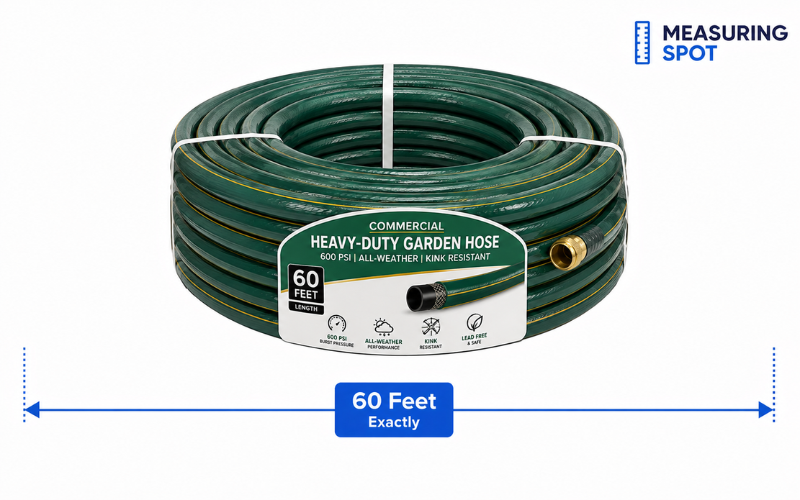
If you walk down the landscaping aisle of any major hardware store, hoses are sold in standardized increments: 25 feet, 50 feet, 75 feet, and 100 feet. However, commercial-grade washdown hoses, contractor rubber hoses, and custom-coiled RV hoses frequently come in 5/8-inch, 60-foot lengths.
Uncoiled across a lawn or driveway, a 60-foot hose extends from the sillcock at the rear corner of a house straight to the opposite edge of a typical backyard perimeter fence.
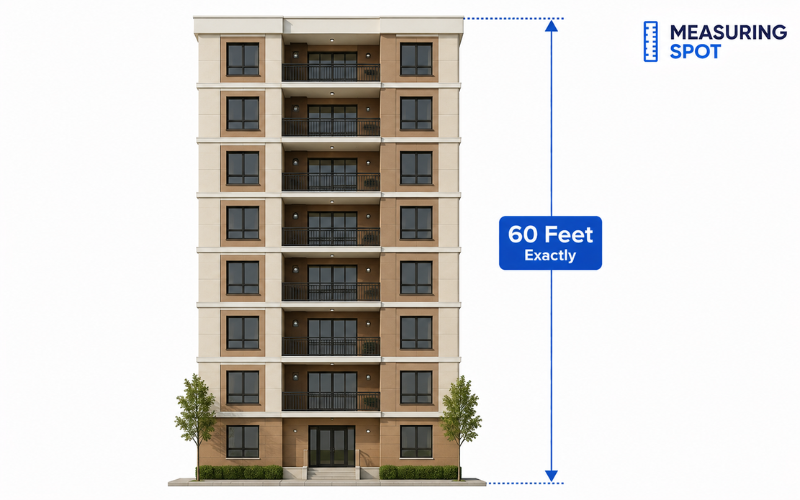
8. A Six-Story Residential Building (Height) 🏢
In residential architecture, a single story (floor to ceiling, plus floor joists and ductwork) averages 10 feet in finished height. A classic six-story brownstone, apartment block, or mixed-use mid-rise measures right around 60 feet from street grade to the roofline parapet.
Looking up from the sidewalk to the top of a six-story building gives you an accurate sense of vertical perspective for 60 feet.
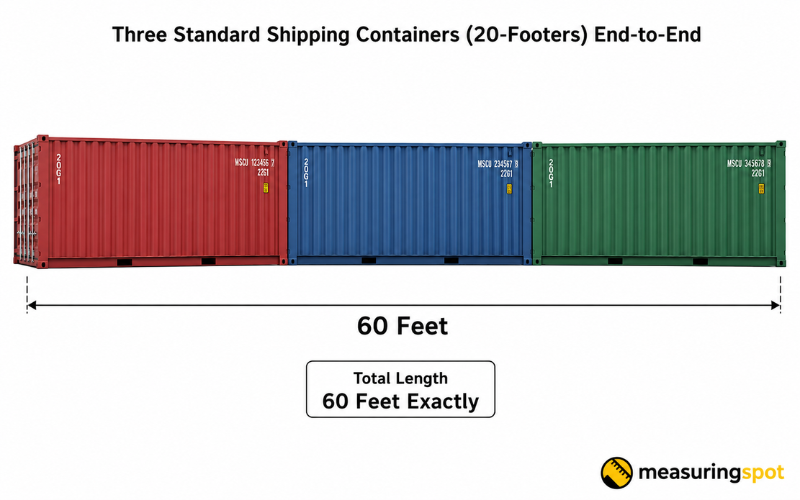
9. Three Standard Shipping Containers (20-Footers) End-to-End 🚢
Intermodal shipping containers are the backbone of global trade, built to strict ISO dimensional specifications. The most common standard dry container is the 20-foot unit (1 TEU).
Placing three 20-foot shipping containers end-to-end creates a steel corridor running exactly 60 feet long:
$$3 \times 19.875\text{ ft} \approx 60\text{ ft}$$
Because they are rigid, uniform, and recognizable at ports and rail yards, this triplet formation serves as a reliable mental baseline.
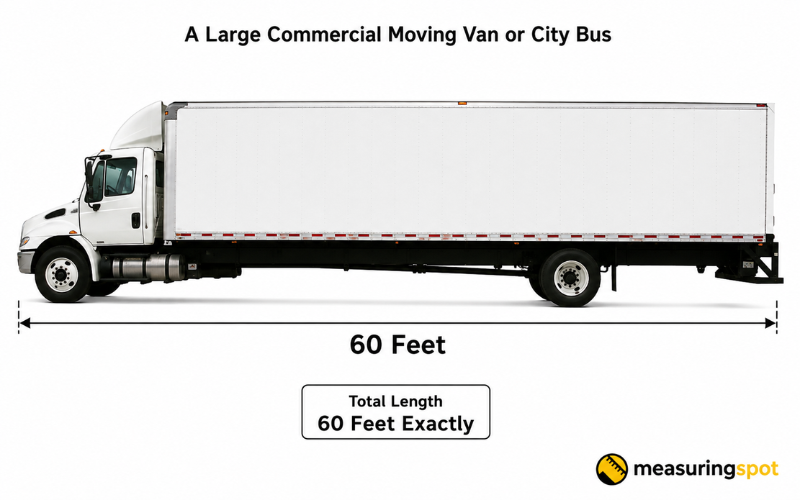
10. A Large Commercial Moving Van or City Bus 🚌
While standard municipal commuter transit buses measure 40 feet in length, long-distance motorcoaches and multi-axle municipal express buses hit 45 feet.
When you look at a heavy-duty straight commercial moving truck paired with an attached utility car-hauler trailer, or an articulated city bus’s primary cab chassis plus its hitch section, you routinely arrive at a combined operational footprint of approximately 60 feet.
Physical Comparison Breakdown: 60-Foot Objects 📊
| Object / Reference | Category | Exact Length / Height | Context / Common Setting |
| Regulation Bowling Lane | Sports | 60 ft (foul line to headpin) | Indoor recreation centers |
| Semi-Truck & Trailer | Transportation | ~60–65 ft total | Highways, freight terminals |
| Little League Baseline | Sports | 60 ft (base to base) | Youth sports diamonds |
| Class 1/2 Utility Pole | Infrastructure | 60 ft (total timber length) | Major suburban and rural roadways |
| 4 Mid-Size Sedans | Daily Life | ~60 ft (bumper-to-bumper) | Parking lots, roadside curbs |
| Adult Bowhead Whale | Marine Biology | Up to 60 ft | Arctic & Sub-Arctic waters |
| Six-Story Mid-Rise | Architecture | ~60 ft (height) | Urban residential neighborhoods |
| 3 Intermodal Containers (20ft) | Logistics | ~60 ft combined | Ports, cargo ships, train depots |
BioWiki Reference Card 📁
| Parameter | Specification & Conversion Data |
| Target Length | 60 Feet (60′ / 60 ft) |
| Metric Value | 18.288 Meters (1,828.8 cm / 18,288 mm) |
| Yard Equivalent | 20 Yards |
| Survey Paces | ~22 to 26 natural strides |
| Vertical Aspect | Equal to a 6-story residential building |
| Sound Travel Time | ~0.053 seconds at sea level (70°F) |
| Common Uses | Little League diamond baselines, bowling alleys, utility poles |
How to Estimate 60 Feet Without a Tape Measure 🛠️
When you are out in the field, inspecting a yard, or mapping out a construction project without a 100-foot reel tape, use these physical estimation methods:
- The Stride Method: The average step length for a grown adult is approximately 2.5 feet. Walking at a steady pace and counting your steps gives you 60 feet in 24 continuous strides.
- The Car Trick: Look at cars parked along the street. Four standard sedans or three extended-cab pickup trucks (around 19 to 20 feet each) cover 60 feet of asphalt.
- The Tennis Court Perspective: A regulation singles tennis court is 78 feet long from baseline to baseline. The service box line sits 18 feet in from the baseline on each side, meaning the total service playing zone from service line to opposite service line is 42 feet. Standing a couple of steps back from the baseline to the net is roughly 40 feet; extending past the net by half the other court brings you directly to 60 feet.
Frequently Asked Questions ❓
How many meters is 60 feet?
60 feet is equal to 18.288 meters. To convert feet to meters yourself, multiply the number of feet by 0.3048:
$$60 \times 0.3048 = 18.288\text{ m}$$
How many seconds does it take to walk 60 feet?
At an average human walking speed of 3 to 3.5 miles per hour (roughly 4.4 to 5.1 feet per second), walking 60 feet takes approximately 12 to 14 seconds at an unhurried, steady pace.
Is 60 feet the same as a cricket pitch?
Very close. A regulation cricket pitch is 66 feet (22 yards or 1 chain) from wicket to wicket. A 60-foot span falls just 6 feet short of the full bowling crease distance on a regulation cricket ground.
How many stories is a 60-foot building?
A 60-foot structure corresponds to roughly 5 to 6 stories for a residential building (where ceilings and joists run 10 feet per floor). In modern commercial buildings with large open plenums for ventilation and electrical conduits (12 to 14 feet per floor), a 60-foot height typically represents 4 to 5 floors.
Related Posts
- 10 Common Everyday Things That Are 1 Foot Long
- 10 Common Things That Are 2 Feet Long
- 10 Common Things That Are 3 Feet Long
- 10 Common Everyday Things That Are 4 Feet Long
Conclusion 📌
Visualizing distances like 60 feet does not require carrying a bulky measuring tape once you link the number to tangible objects in the everyday world. Whether you gauge it by the full stretch of a regulation bowling lane, the combined span of four parked sedans, the towering height of a six-story residential building, or the sprint between bases on a youth ballfield, having these recognizable benchmarks makes estimating 18.3 meters immediate and accurate. Keeping these practical anchors in mind turns an abstract measurement into an intuitive, everyday frame of reference.
FOR MORE MEASUREMENTS VISIT: MEASURINGSPOT